Why the Moon Changes Position Against the Stars
Why the Moon changes position against the stars becomes clear when you separate its eastward orbital drift from the sky’s nightly westward sweep.
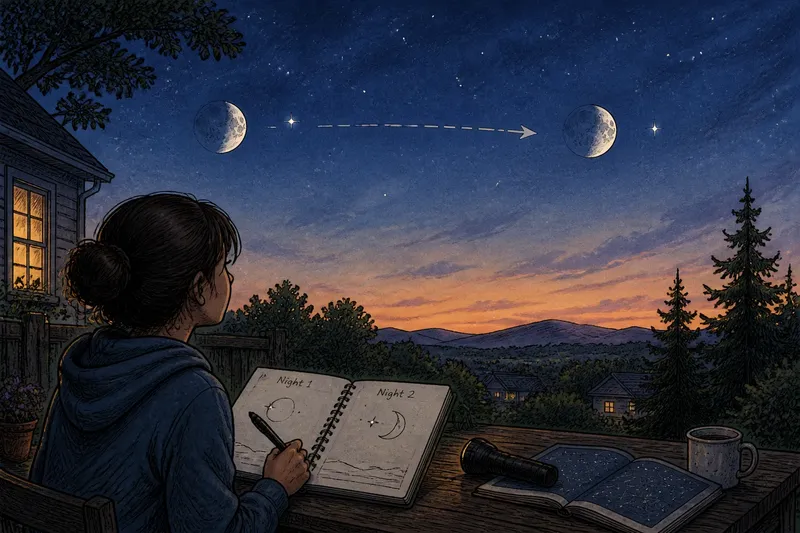
At dusk, Maya spots the Moon beside a bright star and sketches their positions in a notebook. The next evening, she looks again at a similar time: the Moon has shifted east relative to the stars, although it has appeared to travel west across the sky during each evening. Why the Moon changes position against the stars makes sense once those two motions are kept separate.
What is moving, and what only appears to move?
Imagine Maya observing from a backyard in the Northern Hemisphere, with a clear view of the southern sky. She notes the Moon’s position relative to the same nearby stars. Her sketch records which object appears to the left or right of another; it is not a precise measurement.
Over a single evening, Earth’s rotation makes the sky appear to turn. Earth rotates from west to east, carrying Maya eastward with the ground beneath her. As a result, stars, planets, and the Moon generally appear to move across the sky toward the west, rising in the east and setting in the west.
The Moon also moves in its orbit around Earth. Compared with the distant stars, it travels eastward along its path from night to night. Think of a person walking on a moving sidewalk: the sidewalk carries the person along, while the person’s own movement changes their position relative to it. The analogy is not exact, but it separates the sky’s apparent daily sweep from the Moon’s orbital shift.
Why does the Moon drift eastward?
The background stars are so far away that their positions look nearly fixed over a few nights. The Moon is much closer, and its changing position against that distant backdrop reveals its orbit. As it travels around Earth, it appears farther east from one night to the next.
“Eastward” describes the Moon’s position relative to the stars, not the direction it seems to travel during an evening. Earth’s rotation makes the Moon appear to move westward across the local sky during the night. From one evening to the next, its orbital motion shifts its position eastward against the stars. Both descriptions can be true because they use different reference points and time spans.
Say Maya’s first sketch places the Moon just west of a recognizable star. On a later evening, she observes at roughly the same time and finds the Moon east of that star. The observable result is a changed Moon-to-star position, while the star pattern remains familiar. The exact shift depends on when she looks and where the Moon is in its orbit.
Why does the Moon rise later on later nights?
Because the Moon has moved eastward along its orbit, Earth must rotate a little farther to bring it back to the same local position in the sky. The Moon therefore tends to rise later on successive nights rather than returning to the horizon at precisely the same clock time. This follows from the same orbital drift that changes its position against the stars.
Clouds, buildings, hills, and the Moon’s changing height can make rise times difficult to compare by eye. A more direct question is, “Where was the Moon relative to the stars when I observed it?” Rise time depends strongly on the horizon and observing time; the Moon-to-star position directly tracks the shift Maya wants to see.
How can Maya tell the two motions apart?
Maya can use a simple observing routine and let each note answer a specific question:
- Choose a reference star. Check whether a bright star is close enough to the Moon for an easy comparison. If it is, use it as the reference; if not, choose a nearby recognizable star or consult a star chart.
- Keep the viewpoint consistent. Check whether the same spot offers a clear view and note landmarks such as a tree or roofline. If the view is unchanged, compare the sketches directly; if not, record the new landmark or move to a clearer spot and note the change.
- Record the time and date. Check both for every observation. If the times are similar, compare the Moon’s position across nights; if they differ substantially, treat the views as a comparison of different times rather than attributing all change to the Moon’s orbit.
- Make a quick sketch. Check where the Moon lies relative to the reference star. If the pairing is clear, use the sketch for the next comparison; if clouds or glare obscure it, note that the position is uncertain and try again on a clearer evening.
- Compare on another night at a similar time. Check whether the Moon’s position against the star has changed. If it has, the shift is consistent with the Moon’s eastward orbital drift; if the star is no longer visible, choose another recognizable star and avoid treating the two sketches as a direct pairing.
- Note the Moon’s phase. Check the shape of its lit portion and record it as context. If the phase is visible, keep the note alongside the position; if clouds or glare hide it, leave the phase blank rather than using it as a substitute for tracking the Moon against stars.
Imagine Maya’s starting notes show the Moon just west of a named reference star at about the same evening hour on two consecutive clear nights. She checks that she observed from the same yard, identifies the star in both sketches, and compares the Moon’s side of the star. In the later sketch, the Moon lies east of it, so her recorded result is an eastward change relative to the stars. If the second sketch were made several hours later instead, she would mark the comparison as affected by the sky’s daily rotation and wait for a similar-time observation before drawing that conclusion. A phone or paper sky chart can help identify the star, but no telescope is needed for this comparison.
What can the Moon’s changing position tell an observer?
The Moon’s steady eastward progress is a visible clue that it is not fixed against the star background. Its position also changes alongside its phase because the arrangement of the Sun, Earth, and Moon changes as the Moon travels around Earth.
Not every night offers a clear comparison. The Moon may be near the horizon, hidden by cloud, or set against a sparse patch of stars. In Maya’s invented observing sequence, a later clear evening gives her a useful comparison: the reference star is recognizable, while the Moon sits in a new position beside it. The separate notes help distinguish that changing relationship from the sky’s shared daily sweep.
Which details help explain the Moon’s shift?
Does the Moon move east or west?
Against the background stars, the Moon shifts eastward as it orbits Earth. During a single evening, it usually appears to move westward with the rest of the sky because Earth rotates from west to east.
Why does the Moon look westward during the night?
Earth’s west-to-east rotation carries an observer eastward with the ground, so distant sky objects appear to cross the sky toward the west. The Moon’s orbital motion is easiest to distinguish by comparing its position with stars across successive observations.
Do the stars move with the Moon?
From an observer’s viewpoint, the stars share the sky’s apparent daily rotation. Their patterns stay nearly fixed relative to one another over a few nights, while the Moon changes its place among them as it travels around Earth.
Can I see the shift without a telescope?
Yes. A clear view, a nearby star, and simple notes are enough to compare positions. A phone or paper sky chart can help identify the star, but the useful observation is the Moon’s changing place beside it.
To understand why the Moon changes position against the stars, keep the reference explicit: “westward across the evening sky” describes apparent motion from Earth’s rotation, while “eastward relative to the stars” describes the Moon’s orbital drift. A notebook makes the distinction visible without making the directions seem contradictory.
Label each sketch with its reference, such as “westward across the evening sky” or “eastward relative to the stars.” That small note helps you interpret the drawing later, even if the observing time or viewpoint changed.