A First Evening of Looking at the Moon
A first evening of looking at the Moon needs no equipment: follow its changing shape and position to practice patient, attentive skywatching.
You step outside after dinner, pause by the doorway, and notice the Moon above a roofline. A first evening of looking at the Moon can begin right there, with bare eyes and a few unhurried minutes. The aim is not to collect sightings. It is to notice what changes as you stay with one view.
Where can you settle in?
Choose a place where you can see a useful patch of sky without needing to cross a road, climb, or stand somewhere uncomfortable. A yard, porch, park bench, or open stretch of sidewalk may work. Look for a view that includes a steady reference, such as a roof edge, a tree crown, or a distant hill. The reference helps you notice the Moon’s position without turning the evening into a measuring exercise.
Make yourself comfortable before you begin. If you are outdoors, a chair can help you look up without straining your neck. Bring a light layer if the air feels cool, and keep a phone or bright flashlight put away unless you need it to move safely. There is no special dark adaptation required for a casual look at the Moon; simply letting your eyes settle can make the scene feel less abrupt.
Do not stare at the Sun while trying to locate the Moon, especially in daylight or near sunset. If the Moon is low, buildings or trees may temporarily hide it. That is a reason to choose another safe viewing spot, not to step into traffic or onto an unstable surface.
What does the Moon’s shape tell you?
Start with the boundary between the bright part and the dark part. That boundary is called the terminator. It is not a line painted on the Moon: it marks the region where sunlight gives way to lunar night. Depending on the Moon’s phase, the bright area may appear as a thin curve, a broad half-circle, or a nearly complete disk.
Notice the shape before naming it. Is the lit portion narrow or wide? Does the curve bow toward the left or the right from where you are standing? The answer can depend on your position, the Moon’s orientation, and how you are holding your head, so a quick sketch may be more useful than a confident label. Draw a circle, shade the dark portion, and add a small mark for the brightest edge.
Clouds can soften the outline or make the Moon look dimmer, but they do not change its phase. Likewise, the familiar face-like markings are surface patterns, not passing shadows. For a first evening, seeing those broad dark and bright regions is enough; there is no need to identify individual craters with unaided eyes.
How can you notice the Moon’s position?
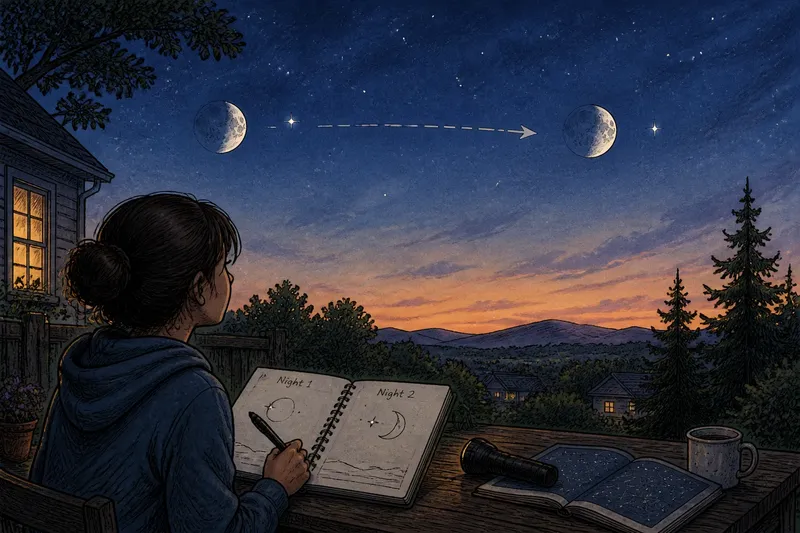
Pick one nearby landmark and note where the Moon sits in relation to it. You might write, “above the left side of the maple,” or “just clear of the apartment roof.” Avoid treating the landmark as a measuring instrument. Its job is to give your memory something concrete to hold.
After a quiet interval, look again from the same place. The Moon may seem to have shifted relative to the landmark as Earth turns. This apparent motion is gradual, and a short pause may reveal little. A longer pause, a later glance, or another look on a different evening can make the change easier to notice. If clouds interrupt your view, simply return when the sky opens.
Keep the comparison fair: stay in the same spot if you can, and distinguish movement in the sky from a change in your viewpoint. A tree can appear to slide against the Moon when you walk several steps, just as a nearby fence post seems to move against a distant building from a car window. The Moon is far away; your position on the ground is what changed in that case.
What is worth writing down?
Field notes do not need technical vocabulary. Record only details you can check: the approximate time, the shape of the lit portion, the landmark nearby, and the weather that affected the view. Add one question you genuinely have. A note such as “thin crescent, low above the roof, hazy edge; why is the bright side tilted?” gives you a useful starting point next time.
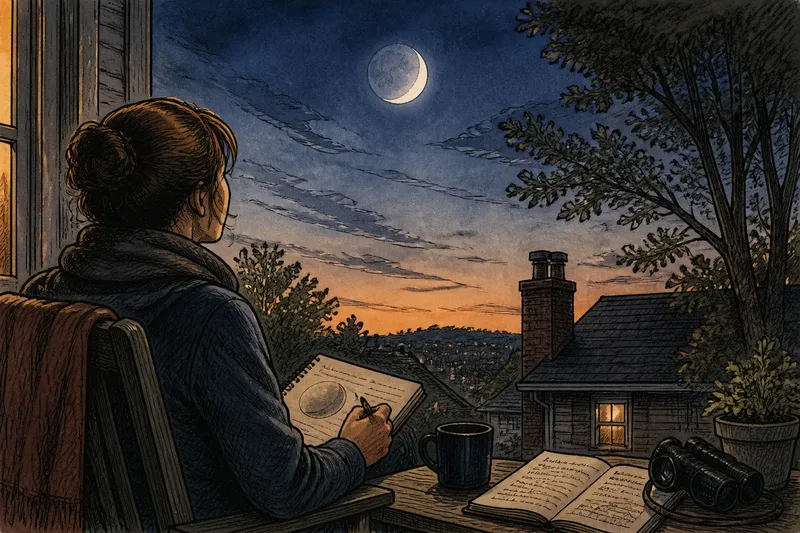
Say you step onto a porch and see a crescent above a chimney. You sketch its curve and note that the bright side faces toward the open part of the sky. After sitting for a while, you look again and find the crescent still near the chimney, with its outline easier to see as a thin cloud passes. The expected result is not a dramatic change, but a more precise account of what the sky actually showed.
A drawing can preserve orientation better than a sentence, but either is fine. Mark which direction you faced if you know it; if not, use a landmark description. Leave blank space rather than filling gaps with guesses. Observing includes recognizing when the view does not support a firm conclusion.
What should you look for as the evening changes?
Light and atmosphere alter the scene. Near the horizon, the Moon may look warmer in color or less sharp because its light passes through more of Earth’s atmosphere. Thin cloud, smoke, or haze can change contrast. These effects are about the path of the light and the air between you and the Moon, not a change in the Moon’s surface.
As the sky darkens, the Moon’s bright edge may stand out more clearly. Nearby lights can make the surrounding sky harder to see, while a passing cloud can temporarily hide detail. Take the conditions as part of the observation rather than treating them as a failed session. A note that says “low and hazy” is more useful than an imagined crisp view.
If you have a view through a window, remember that reflections and glass can soften or double the image. Step outside only if it is safe and comfortable; no observation is worth an awkward or risky position. For an easy comparison, glance at the Moon from the window, then from a safe outdoor spot, and notice whether the outline becomes cleaner.
Which questions can guide a first look?
Does the Moon make its own light?
No. Sunlight illuminates the lunar surface, and the visible shape depends on how much of its sunlit half faces Earth. The dark portion is still there; it is simply receiving little direct sunlight from our viewpoint.
Why does the Moon seem larger near the horizon?
The horizon can make the Moon appear larger than when it is high in the sky, an effect tied to human visual perception. Its apparent size is not reliably judged by comparing it with a nearby roof or tree, since those objects are much closer and occupy different parts of the scene.
Can I see craters without a telescope?
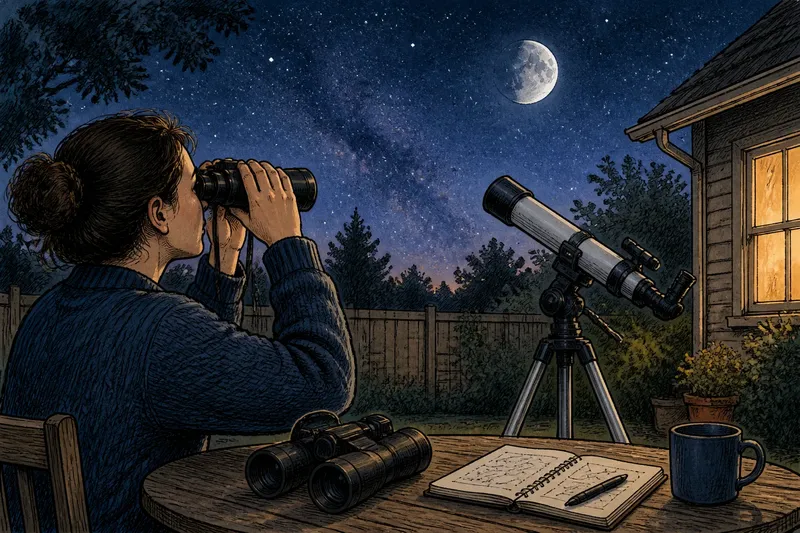
With unaided eyes, you can notice broad dark regions and some variations in brightness, but small craters are generally too fine to resolve. The terminator may make surface relief easier to appreciate through optical equipment, but this first evening can focus on the large-scale shape and light.
What if I cannot see the Moon tonight?
Cloud, buildings, timing, or the Moon’s position can keep it out of view. You can still record the sky’s condition and return another evening; a clear view is not a requirement for keeping useful notes.
How can you close the evening?
Before going inside, look once more and name one detail you had not noticed at first. It might be the angle of the crescent, a cloud crossing its edge, or how the Moon sits against the roofline. Keep the note modest and specific. A first evening of looking at the Moon works best when it leaves you with a sharper observation, not a demand to have seen everything.
If you return on another night, bring the same simple habit: choose a landmark, describe the lit shape, and write what changed in your view. The Moon can serve as a familiar point of attention, much like a page corner you use to keep your place in a book. You do not need to rush ahead; noticing where you are is already part of learning the sky.