Binoculars or a Small Telescope for a First Look?
Binoculars or a small telescope: compare field of view, handling, and observing comfort to choose an instrument that fits your first nights outside.
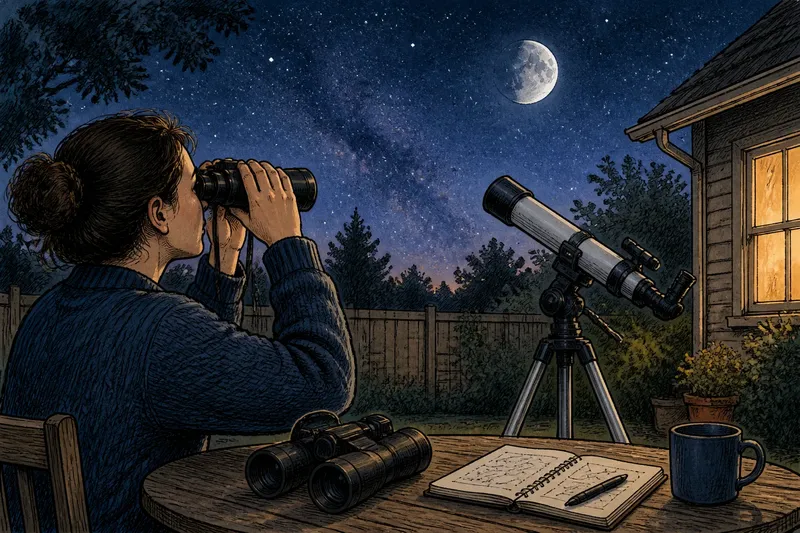
You step outside after dusk, spot a bright cluster between the trees, and wonder whether binoculars or a small telescope will make it easier to look. For a first look, the better choice depends less on maximum magnification than on what you want to find, how steadily you can hold the instrument, and how much setup feels comfortable.
What changes when you switch instruments?
Binoculars use two matching optical tubes, one for each eye. A small telescope gathers light through a single tube and presents the view through an eyepiece. Both can show the Moon, bright star groups, and other accessible sights, but they frame the sky differently and ask different things of the observer.
Field of view means the width of sky visible through an instrument at once. A wider view gives more context: a star group is easier to recognize as a whole, and a bright object is less likely to slip outside the frame while you are learning to point. Many binoculars give a comparatively broad view, while a telescope with a higher-power eyepiece generally shows a narrower patch.
Magnification enlarges the apparent view, but it also makes movement more noticeable. The sky seems to drift through the frame as Earth turns, and small hand movements can shift a high-power view substantially. Think of the difference between looking through a wide window and peering through a narrow paper tube: the narrow opening can reveal a detail, but it takes more care to keep the subject in sight.
When are binoculars the easier choice?
Binoculars suit someone who wants to scan broad regions of sky, move quickly between targets, or carry one compact instrument outdoors. They are often straightforward to point because you can raise them toward a bright object while keeping both eyes open. That natural posture can make the first session feel less like operating equipment and more like looking around.
They are especially comfortable for bright, extended sights: the Moon as a whole, a loose star group, or a broad patch of stars away from city glare. Seeing with both eyes can feel relaxed, though it does not eliminate arm fatigue. A heavier pair may become tiring when held overhead, so weight and grip matter as much as the label on the box.
Binoculars also work well when the observer is not ready to manage a mount. You can sit in a reclining chair, brace your elbows against your body, or rest them on a stable surface. These simple supports reduce shake without adding equipment. If you wear glasses, check whether the eyecups can be adjusted to give you a comfortable view while wearing them.
What does a small telescope make easier?
A small telescope is a stronger fit when you want to examine a narrower target, change eyepieces, or use a mount that helps hold the instrument in place. It can make lunar features easier to inspect than they are through a broad binocular view. The tradeoff is that locating and keeping a target centered usually calls for more deliberate handling.
Telescopes vary in design. A refractor uses lenses at the front of the tube; a reflector uses a mirror. For a beginner, the practical questions are often more immediate: Does the mount feel stable? Can you point it without a struggle? Is the eyepiece at a comfortable height? A modest telescope on a shaky mount can be less satisfying than a simpler instrument held steadily.
Many small telescopes use interchangeable eyepieces. A lower-power eyepiece usually gives a wider view and can make it easier to find a target; a higher-power one narrows the view and makes tracking more demanding. The telescope’s aperture, optical design, eyepiece, mount, and viewing conditions all affect what the image looks like. More magnification alone does not create more detail.
Which instrument matches your observing habits?
- Choose binoculars if you want quick setup, broad views, and an instrument that can move easily from the yard to a dark-sky outing.
- Choose a small telescope if you are drawn to closer inspection of the Moon and are willing to learn how a mount and eyepieces work together.
- Consider binoculars with a support if you like broad views but expect arm fatigue; a stable rest can make longer looks more comfortable.
- Consider a telescope with a steady mount if keeping a target centered matters more to you than sweeping across a large area of sky.
- Try before buying if possible. A local astronomy club, library program, or public observing event may let you compare instruments in person.
Say you are choosing for a small backyard and mostly want to follow the Moon’s changing shape while occasionally scanning a star group. If carrying and setting up gear feels like a chore, a comfortable pair of binoculars may be the more inviting first instrument. If you already enjoy adjusting a tripod and want to inspect lunar details, a small telescope with a stable mount may better fit your evenings.
How should you compare comfort and setup?
Before deciding, handle the instrument in daylight, pointed at a distant object on the ground. Check whether you can focus without awkward finger movements, whether the eyepiece meets your face comfortably, and whether the view stays steady as you breathe normally. Do not point optical equipment at the Sun; even a brief look through binoculars or a telescope can cause severe eye injury.
For binoculars, compare the grip, focus wheel, eye relief, and how the weight feels with your arms raised. For a telescope, look at the tripod or mount as well as the tube. A simple mount that moves smoothly can be easier to use than a more elaborate arrangement that wobbles or feels unfamiliar. The instrument’s storage case and the space needed to carry it outside also affect how often it is likely to be used.
Check the maker’s instructions for operation, compatibility, and care, since fittings and controls vary by model. For an optical instrument, avoid treating advertised magnification as a complete measure of quality. A stable, clear view at a comfortable power is more useful than an enlarged image that shakes or becomes difficult to focus.
What do beginners ask about binoculars and small telescopes?
Are binoculars good for astronomy?
Yes. Binoculars can show broad star fields and the Moon, and they are simple to carry and point. Their usefulness depends on choosing a view that suits their size and on supporting them comfortably.
Can a small telescope show more than binoculars?
It can offer a narrower, more magnified view that helps with closer inspection of some targets. That does not make every view better: finding, centering, and holding a target may take more effort.
Do I need a tripod for binoculars?
Not always, especially for brief looks with a light pair. A chair, wall, or dedicated binocular support can reduce arm strain if you want to observe for longer.
Is higher magnification better for a first instrument?
Not by itself. Higher magnification narrows the field and makes movement more apparent, so a lower-power view may be easier for finding targets and enjoying the surrounding sky.
What is the clearest way to choose?
Start with the kind of looking you expect to do most. For broad views, casual scanning, and easy transport, binoculars are often the natural fit. For a steadier, closer look at selected targets, a small telescope makes sense if its mount and setup feel manageable.
If you are undecided, borrow each type or visit a public observing night before spending money. Try to view the same bright target through both, then notice which instrument makes it easier to settle in, focus, and keep looking. That firsthand comparison can tell you more than a magnification number, and it keeps the choice centered on the simple reason to own an instrument: using it comfortably under the sky.