The Constellation Line Myth: Stars Do Not Share a Picture
Constellation lines map patterns from Earth, not nearby groups in space. Learn how to compare a familiar sky picture with the stars’ true distances.
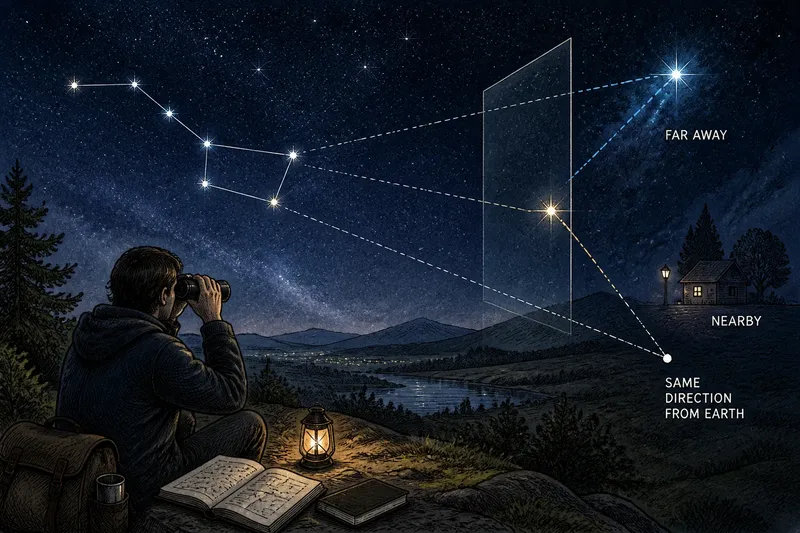
You trace the Big Dipper’s handle in the evening sky and notice how neatly its stars seem to continue one another. The constellation line myth begins when that visual rhythm is mistaken for a physical arrangement: the stars share a direction from Earth, not necessarily a neighborhood in space.
What does a constellation line represent?
A constellation is a recognized region of the sky with an established name and boundary. The familiar figure drawn within it is a way to pick out a pattern, not a claim that its stars form a single object. In astronomy, the boundary identifies an area on the celestial sphere—the imaginary surface used to describe directions in the sky.
A line drawn between stars is a cue for the eye. It has no physical counterpart between those stars. Think of a connect-the-dots picture: the strokes help you recognize a shape, but they do not tell you what lies between the dots.
Different charts can draw different figures from the same stars. Some show only the best-known pattern; others add stars or use another arrangement. That variation tells you the drawing is an aid to recognition, not a diagram of how the stars are joined in space.
Why do stars at different distances make one pattern?
Looking up, you see where stars appear across your field of view. Your unaided eyes do not provide a dependable sense of how far away each one is. Two stars may sit close together in the sky because they lie in nearly the same direction, even when one is much farther from Earth. Their apparent spacing is not a measure of their separation from each other.
Imagine two lamps viewed through a window from one spot. They might overlap in your view although one stands nearby and the other far down the street. Step sideways, and the overlap changes. Stars can appear aligned from Earth in much the same way, while their actual locations occupy very different parts of space.
Constellation figures compress that depth into a sky pattern. They are useful for recognizing directions, but they leave out the distance dimension. A drawing that looks like a compact shape can therefore include stars that are not physically close.
How can you check what a star pattern tells you?
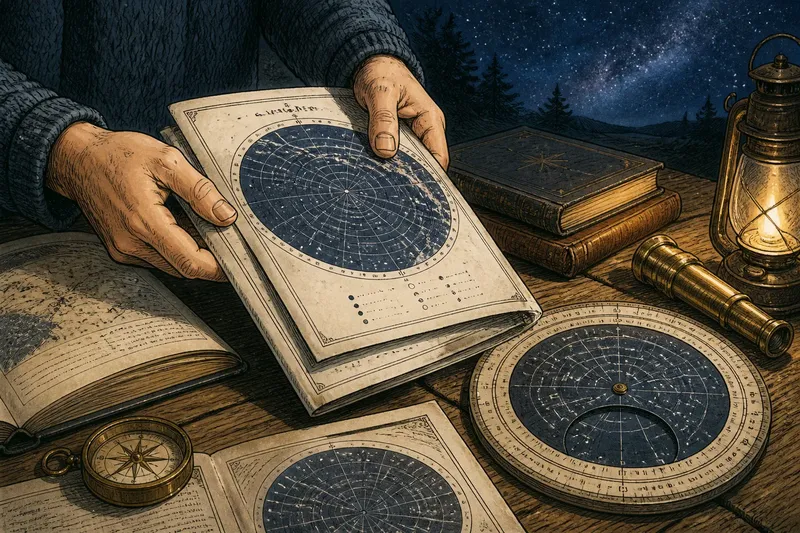
Use a star chart to identify the pattern, then consult a reliable astronomy reference for information the chart may omit. The Big Dipper is a convenient landmark, but it is an asterism—a familiar star pattern within the larger constellation Ursa Major—not a constellation by itself.
- Check the chart legend. If its lines are identified as pattern guides, use them to recognize stars; if the legend gives them another meaning, follow that explanation instead.
- Check whether distances are included. If the chart has no distance key or data panel, treat it as a direction guide; if it does, read the stated units and scope before interpreting the values.
- Check the star’s identification. If a catalog entry matches the star’s name or designation and position, use it for that object; if the match is uncertain, confirm the identity before comparing data.
- Check what a distance value describes. If it gives distance from Earth, use it as one coordinate clue; if you need the separation between two stars, seek their positions as well.
- Check whether a claimed group has shared motion or origin evidence. If an astronomy source identifies a physical association using such evidence, distinguish that group from the whole constellation; if it offers only a drawing, do not infer a physical link.
- Check the chart’s viewing date and location when relevant. If the chart is intended for your sky and time, use it to locate the pattern; if not, choose a chart suited to your location and observing time.
Say you recognize two stars in a pattern and find matching entries for both in a star catalog. The entries list distances from Earth, but the catalog does not give their mutual separation. You can conclude that the stars lie at different distances from us; to decide how far apart they are from each other, you would also need their sky positions and a three-dimensional comparison. The drawing still helps you find them, but it cannot answer that spatial question on its own.
What can distance data establish?
A star’s distance tells how far it is from the observer. Astronomy references commonly express distance in light-years or parsecs. A light-year is a distance unit, not a measure of a star’s age. Neither unit, by itself, tells you how far one star is from another.
To compare two stars in space, you need both their distances from Earth and their directions in the sky. If their directions are nearly the same but their distances differ, they may be widely separated. If their directions differ, the angle between those directions also matters. A chart’s flat pattern cannot supply that full comparison.
Brightness does not solve the problem. A star can look bright because it is close, because it emits more light, or because of a combination of factors. Appearance alone is not a reliable distance scale.
Can stars in a constellation belong to a real group?
Yes, some stars visible in the same region of sky can belong to a physical association, such as a star cluster. Astronomers assess that relationship using information such as position, distance, and motion—not simply because the stars fit a familiar drawing.
A constellation boundary marks a region as seen from Earth. It does not enclose a set of stars with a shared origin, and a physical group can include stars that do not match the constellation’s outline. The boundary and the group answer different questions: one locates a patch of sky, while the other describes a relationship in space.
What else do people ask about constellation lines?
Are constellation lines actual paths between stars?
No. They are drawn to help people recognize patterns, and they do not represent paths or material links in space. A chart’s legend can clarify what its particular marks mean.
Can I tell which star is farther away by looking?
Not reliably from a constellation pattern. Apparent brightness depends on a star’s light output as well as its distance, so use an astronomy reference for distance information.
Do stars in one constellation move together?
Not merely because they appear within the same sky region. Astronomers compare positions, distances, and motions to identify stars that are physically related.
Will binoculars reveal how far apart stars are in space?
Binoculars can show additional stars and make some sky patterns easier to examine, but magnification does not reveal their depth. Use distance and position data to investigate their arrangement in space.
How should you use a constellation pattern?
Treat the figure as a way to locate and remember stars, not as a model of their spatial arrangement. A chart can help you point toward a sky region, identify a named star, or follow a familiar sequence. For questions about physical closeness, consult a source that includes distance and position information.
The constellation line myth is easier to avoid once you ask what each tool is meant to show. A pattern helps your eyes recognize a part of the sky; catalog data helps describe where its stars are in space. Keep those jobs separate, and the drawing remains useful without asking it to explain the depth it leaves out.